In-Conference Trip for Faculty
- Fo Guang Shan:
Fo Guang Shan (literally "Buddha's Light Mountain") is an international Chinese Mahayana Buddhistmonastic order based in the Republic of China (Taiwan), and one of the largest Buddhist organizations. The headquarters of Fo Guang Shan, located in Kaohsiung, is the largest Buddhist monastery in Taiwan. The organization itself is also one of the largest charity organizations in Taiwan. The order also calls itself the International Buddhist Progress Society.
Venerable Master Hsing Yun founded in Fo Guang Shan in 1967. Since it has evolved from a mountaintop bamboo forest to the largest Buddhist monastery in Taiwan. Master Hsing Yun has inspired the selfless devotion of over 1000 monastics as well as the ardent support of many lay devotees to assist him in bringing confidence, joys, hops, and providing service to countless others. Presently Fo Guang Shan has over 200 branch temples throughout the world carrying out the goals of propagating Humanistic Buddhist and establishing a Pure Land on earth.
 In May 1997 Fo Guang Shan decided to close its doors to the general public to give monastics cloistered atmosphere they need for their Buddhist practice. At the end of 2000 President Chen Shui-bien and government officials from Kaohsiung visited Fo Guang Shan bringing with them the wish from their constituents that Fo Guang Shan re-open its mountain gate. After due consideration, Fo Guang Shan decided to re-open the monastery to some extent thereby providing the public with a Pure Land environment in which to practice Buddhism.Picture source: http://www.fgs.org.tw/BMC/pagoda.htmlText Source: http://en.wikipedia.org/wiki/Fo_Guang_Shan
official website of Fo Guang Shan: http://www.fgs.org.tw/english
Fo Guang Shan - Buddha Memorial Center:
The Buddha Memorial Center is a Mahayana Buddhist cultural, religious and educational complex located in Taiwan’s Kaohsiung City, Dashu District. Construction of the center began in 2008, and the complex was opened to the public in December 2011.
Picture Source: http://www.fgs.org.tw/BMC/memorial.htmlHere keeps one Buddha` tooth-relic of Gautama Buddha from the Tibet. This building incorporates both traditional and modern Chinese feature, as well as international elements. It will fulfill spiritual needs of the people and become aspiritual focal point for many in the world. The Buddha Memorial Center is a once-in-a-lifetime opportunity to must-visit holy palace !
Text Source: http://en.wikipedia.org/wiki/Buddha_Memorial_Center
Link-other picture: http://www.fgs.org.tw/fgs/fgs_view.aspx
Link-official website: http://www.fgs.org.tw/events/heart/eg/egheart2-1.html - Holy Rosary Cathedral Minor Basilica:
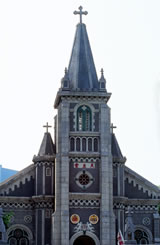
One of the most visited and beautiful tourist attractions in Kaohsiung is Holy Rosary Cathedral. Holy Rosary Cathedral is the oldest Catholic church in Taiwan, located in the southern city of Kaohsiung. It is the seat of the Archbishop of Taiwan. It was first established in 1860 and rebuilt to its present dimensions in 1928. Boasting Gothic and Romanesque features plus one of the island's taller spires, the cathedral is just a few minutes' walk from Love River. Over the entrance, an inscribed stone tablet restates the imperial decree of 1860 which granted the Catholic mission official protection. Inside the nave you'll see confession boxes, the Stations of the Cross, and a traditional pulpit and chancel. Inside the nave you'll see confession boxes, the Stations of the Cross, and a traditional pulpit and chancel.
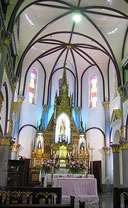 Picture Source: http://khh.travel/tw/spots/SpotDetail.aspx?SN=27
Mass is held daily, with English mass celebrated at 11:00 a.m every Sunday. The cathedral is known throughout Kaohsiung for its annual Christmas Eve celebrations, which lasts the whole evening before Christmas Day. Services are held in various languages, including Mandarin, Taiwanese, English and Tagalog.
Picture Source: http://zh.wikipedia.org/wiki/File:Holy_Rosary_Minor_Basilica-Cathedral.jpg
Text Source: http://travel.mapsofworld.com/taiwan/tourist-attractions-in-kaohsiung/holy-rosary-cathedral.html


In-Conference Trip for Student
- Love River:
 The Love River or Ai River is a river (canal) in southern Taiwan. It originates in Renwu District, Kaohsiung City, and flows 12 kilometers through Kaohsiung to Kaohsiung Harbor. Love River is the spine of Kaohsiung, playing a similar role to the River Thames of London. It is of great cultural significance to the people of Kaohsiung and plays an important role in its economy and tourism. A riverside park, the Love River Park, runs along the riverbank in downtown Kaohsiung City.
 To enjoy the full experience of the Love River, a boat tour has become a popular choice amongst visitors. In 2004, the Transportation Bureau introduced The Love Boat River Tours, which have become very popular. The "Love Boats", gracefully floating up and down the Love River are central to Kaohsiung's developing tourism and one of the best ways to see the city. There are three locations where the river boat tours can be picked up. Plan for an entire afternoon to take a "Love Boat" tour and enjoy a different perspective of Kaohsiung
At night, lights sparkle on Love River and a night market operates in the park. Cultural events such as concerts and the Lantern Festival are often held by the river. Then, you might like to enjoy drinking coffee at cafes of different moods, such as cafe literary and art squares over River Mambo and olden Love River. It is nice to enjoy the aromatic coffee and listen to the music with different moods and tempos, allowing the leisure of the harbor city to relax your body and soul.
Picture Source: http://zh.wikipedia.org/wiki/%E6%84%9B%E6%B2%B3
Text Source:
http://www.newstrick.com/2010/06/love-river-in-southern-taiwan.html
http://khh.travel/en/spots/SpotDetail.aspx?SN=250
http://www.octopustravel-asia.com/events/Jun07/loveriver.asp?siteid=ttgclub&country=RS¤cy=USD - Liuhe night market: (also called Lio Ho night market)
 Picture Source: http://en.wikipedia.org/wiki/Liuhe_Night_Market
You will not be considered to visit Kaohsiung if you miss out Liuhe night market - one of the great night markets inTaiwan.As early as in 1950, more and more stalls came to stationed in Ta Kang Pu of Hsin Hsing District in Kaohsiung, finally forming the well-known "Ta Kang Pu Night Market". The night market is developed into large-scale, known as Liuhe night market. The night market is not far away if you walk from Kaohsiung railway station along the Chung Shan Road straightforward, which takes only ten minutes more, and then turn right to Liuhe Road. In daytime, the market is a straight road, and turns into prosperous market area in nighttime.
There are 138 stalls in Liuhe night market, most of them serve snacks and provide entertainment and games for recreation, the garments and groceries are rarely seen in the market. In particular, the dozens of steak houses boom around the market offering beef steak at reasonable price or family-size package meal. No matter what you like to have, a variety of delicious food from many countries, specialties, cold drinks, ices and seafood here are offered for your choice.
Picture Source: http://en.wikipedia.org/wiki/Liuhe_Night_Market
Text Source: http://www.asia-planet.net/taiwan/kahhsiung-city.htm
Other pictures of Liuhe night market (Picture source: http://en.wikipedia.org/wiki/Liuhe_Night_Market) - Urban Spotlight:
 Officially opened in October, 2001, Urban Spotlight is a famous artistic landmark in Kaohsiung, which stretches 150-meter long covering areas of Wufu 3rd Road and Zhonghua Road to the intersection of Wufu 3rd Road and Zhongshan Road adjacent to the KRT Central Park Station. Designed by 9 local designers, Kaohsiung Urban Spotlight is famed for its splendid light decorations in the evening. This mesmerizing passage is themed “Light”, where visitors are to experience a relaxing evening surrounded by artworks and soft music with no hustle and bustle.
Picture Source: http://khh.travel/tw/spots/SpotDetail.aspx?SN=25
Picture Source: http://en.wikipedia.org/wiki/Urban_Spotlight_Arcade
Urban Spotlight has different looks during day and night. It is a peaceful place with a murmuring stream during the day, while in the evening it is coated with splendid lights, soft music, and artistic ambience when the lights are on. There are also a number of outdoor cafes with chairs set up on the front section offering scheduled live musical performances, making it a wonderful hangout venue for both locals and international oversea visitors.
Text Source:
http://tourisminkaohsiung.blogspot.tw/2011/11/tourism-in-kaohsiung_07.html
http://everluck.hotel.com.tw/eng/attractions.asp?pkey=1669 - New Juejiang:
Kaohsiung's popular shopping areas have been gradually drifting eastward. A new shopping street has been formed across from the old President Department Store on Wufu Road. Its name and concept are based on the Yencheng Jyuejiang Shopping Area.
 Picture Source: http://khh.travel/en/spots/SpotDetail.aspx?SN=224
The New Jyuejiang Shopping Mall is situated near the Wufu road and Jhongshan Intersection and isn't far from Urban Spotlight. The mall focuses on avant-garde, trendy exquisite and unique products. Young people, new fashion, recreation, shopping and dining all collide at New Juejiang, which is rapidly sucking in new businesses to become Kaohsiung's biggest shopping destination. Cinemas, trendy clothes, jewelry, watches, cosmetics, and beauty salons mingle with cafes, American and Japanese fast food restaurants, and all types of stalls to provide a something for everyone. New Juejiang is the place to go in southern Taiwan for imported goods and chic attire, much of it arriving in step with debuts in the fashion capitals of the world.
Text Source:
http://www.iconhotel.com.tw/scenic-en/2011-07-18-15-28-23.html
http://khh.travel/en/spots/SpotDetail.aspx?SN=224
Link for more pictures:
http://guide.easytravel.com.tw/scenic.aspx?CityID=19&AreaID=254&PlaceID=655 - The MRT Formosa Boulevard Station:
 The Kaohsiung MRT Formosa Boulevard Station (Chinese: 美麗島站) is ametro station located in Sinsing District, Kaohsiung. It is a transfer station between the Red Line and the Orange Line. Formosa Boulevard Station is named after the Formosa Boulevard project, a remodelling of Kaohsiung's Jhongshan Road in preparation for the 2009 World Games. The "Formosa" in Formosa Boulevard is in turn named after the incident when a group of Nationalists tried to ban copies of a magazine run by people linked with the Tangwai movement (now the Democratic Progressive Party).
Picture Source: http://en.wikipedia.org/wiki/Formosa_Boulevard_Station
 The station is a three-level, underground station with an island platform and two side platforms. It is located at the junction of Jhongjheng and Jhongshan Road and has 11 exits. The station is known for the name "Dome of Light", also the largest glass work in the world. It was designed by Italian artist Narcissus Quagliata. It is 30 metres in diameter and covers an area of 2,180 square metres. It is made up of 4,500 glass panels. The work not only adds to the beauty of the station, but also adds a new dimension to the art life of the Kaohsiung and creates a new scenic spot in the city. The dome tells the story of human life in four chronologically arranged themes: Water: The Womb of Life; Earth: Prosperity and Growth; Light: The Creative Spirit; and Fire: Destruction and Rebirth, with an overall message of love and tolerance...
Picture Source: http://en.wikipedia.org/wiki/Formosa_Boulevard_Station
Text Source:
http://www.digplanet.com/wiki/Formosa_Boulevard_Station
http://eng.taiwan.net.tw/pda/m1.aspx?sNo=0002121&id=A12-00071 - The MRT Central Park Station:
The Kaohsiung MRT Central Park Station is a station on the Red Line in Sinsing District, Kaohsiung, Taiwan. It was originally planned to be named "Shinkuchan Station" but was later changed to its current name.
Picture Source: http://en.wikipedia.org/wiki/Central_Park_Station_(Kaohsiung)
 The station is a two-level, underground station with an island platform and three exits. It is 197 meters long and is located at the intersections of Zhongshan 1st Rd., Minsheng 2nd Rd., and Wufu 3rd Rd. With the idea of flying, the British designer Richard Rogers announced that Kaohsiung has leapt up and grown up. Blending the station into Central Park, sunlight shines in from the park. Windmill-shaped flowers cover the courtyard grass areas. Walking in the hallway, all the passengers can feel the green tranquility. Around the MRT station is the center of the youth subculture, as well as a hot business and a leisure zone.
Picture Source: http://en.wikipedia.org/wiki/Central_Park_Station_(Kaohsiung)
Text Source: http://en.wikipedia.org/wiki/Central_Park_Station_(Kaohsiung)
http://khh.travel/en/spots/SpotDetail.aspx?SN=1017